Wednesday, May 6, 2020

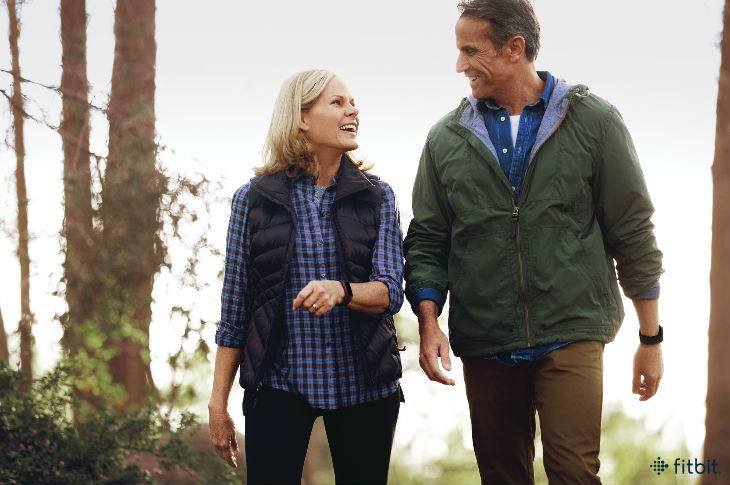
Make An Impact On Heart Health By Signing Up For The New Fitbit Heart Study

Did you know that atrial fibrillation (AFib) affects nearly 33.5 million people all around the world? For them, early detection is key because AFib—the most common form of treated heart arrhythmia—can increase the risk of life-threatening events, such as a stroke or heart attack. 

That’s where the Fitbit Heart Study comes in. Simply put, it’s our first large-scale, virtual study using data collected from Fitbit devices with heart rate tracking. The study may validate the use of Fitbit’s wearable technology to identify episodes of irregular heart rhythm suggestive of AFib. It’s a part of our broader mission to develop innovative tools that help people better understand and manage their heart health. And it’s especially important that these tools are developed because until recently, they were only accessible if you visited a doctor. 

Help make history using your heart. By participating in this study, you can help make the world a healthier place! 

Why is the Fitbit Heart Study important? 

Someone in the US has a stroke every 40 seconds, and atrial fibrillation increases your chances of it. But it’s not always easy to recognize if you have AFib; unfortunately, detection sometimes goes unnoticed or overlooked. You can have it and not know it, as episodes can be sporadic or lack symptoms—and as a result, untreated AFib doubles the risk of heart disease-related deaths, as well as being associated with a five-fold increased risk for stroke. The number of adults developing AFib increases markedly with older age

“Until recently, tools for detecting AFib had a number of limitations and were only accessible if you visited a doctor,” said Steven Lubitz, MD, MPH, principal investigator of the Fitbit Heart Study, cardiologist at Massachusetts General Hospital, and Associate Professor of Medicine at Harvard Medical School. “My hope is that advancing research on innovative and accessible technology, like Fitbit devices, will lead to more tools that help improve health outcomes and reduce the impact of AFib on a large scale.” 

It’s our hope, too. 

“The Fitbit Heart Study advances our heart health efforts [as a company],” said Eric Friedman, Fitbit co-founder and CTO. “Long-term passive heart rhythm assessment with our wide range of affordable devices and 24/7 heart rate tracking technology has the potential to improve earlier identification of AFib, which is a key to reducing the risk of a life-threatening event like stroke. By conducting this important research, we have the opportunity to develop and provide access to technology that may be able to improve public health and save lives.” 

The algorithm used in the Fitbit Heart Study is intended to assess whether a person’s heart rhythm is consistent with AFib, and if it is, will recommend consultation with a doctor. With your help, we can test this algorithm across a large number of people participating. 

How does it work? 

If you’re in the US and are 22 years old or above, you may be eligible to participate and enroll! You’ll need to have a Fitbit device active in your account that tracks heart rate, such as any of our smartwatches, Fitbit Charge 3, Fitbit Charge 4, or the Fitbit Inspire HR. As this is our first large-scale study, we encourage users at higher risk for AFib, such as those aged 65 and older, to join.

Additionally, if at any point you get an irregular heart rhythm notification, we’ll set you up with an independent telehealth provider for a virtual visit, at no cost. You may receive an electrocardiogram (ECG) patch in the mail, at no cost, for a full evaluation.

Enroll in the Fitbit Heart Study today 

The Fitbit Heart Study is the next step in our journey to provide users with innovative heart health tools. By joining, you can help us test the capabilities of our technology, so we can bring it to more people in the future, potentially help to reduce the risk of stroke, and improve population health. The study results will support our applications to global government agencies, including the US Food and Drug Administration, for approvals to make our AFib identification tool available to Fitbit users around the world.

Now, we’re welcoming you to put on your Fitbit device, open your app, and enroll to be a part of this innovative new study with us.

The post Make An Impact On Heart Health By Signing Up For The New Fitbit Heart Study appeared first on Fitbit Blog.


source https://blog.fitbit.com/fitbit-heart-study/

Tuesday, May 5, 2020

How to Cook with Beans

When it comes to pantry staples, beans are pretty hard to beat. Since 2016, the United Nations has been encouraging the world to eat more of them, along with the rest of the pulse family (aka dried beans, peas, and lentils). Why? They’re good for your health and good for the planet, too!

These Humble Heroes Pack a Serious Nutritional Punch

Loaded with gut-friendly fiber, they’re a wonderful way to show your belly some love by feeding the good bugs in your gut. And since your immunity begins in your gut, we know that by nurturing these trillions of microorganisms, in return, they’ll act as your first line of defense against invading bad bugs. Beans are also a great source of plant protein and rich in nutrients like iron and zinc, which play a vital role in immunity, and potassium, which can help you beat high blood pressure. Plus, their low glycemic index can help to control blood glucose levels and potentially fend off sugar cravings. 

A Half-Cup Habit

Aiming to include half a cup of dry peas, beans, lentils, or chickpeas three times a week, instead of red meat, can reduce inflammation and lower your risk of diabetes, heart disease, obesity, and cancer. And a recent study confirms eating just a little bit more—about ¾ of a cup a day—can contribute to weight loss.  

Which is Better: Dried or Canned? 

Dried varieties are the healthiest and most cost-effective way to get more legumes on your plate, although they do require a little more effort to prepare. Simply soak them in cold water overnight. Or, for a quick fix, throw them in a pot, cover them with water, bring to a boil and simmer for a couple of minutes, then remove from heat, put a lid on the pot, and allow to sit for an hour, before continuing with your recipe. A pressure cooker cuts that time to about 25 minutes. Or you can cheat and buy canned versions; just be sure to buy no or low-sodium varieties, or give the regular varieties a good rinse to get rid of the brine water, which is full of salt.

Here are 13 ways to cook with beans: 

  1. Stuffed Peppers with Beans & Corn
  2. Veggie Burgers with Sweet Potato, Black Beans & Quinoa
  3. Quinoa Bowl with Black Beans, Mango & Avocado
  4. Bison Chili with Sweet Potatoes & Black Beans 
  5. Quinoa-Crusted Chicken With Black Bean & Corn Salad
  6. Veggie Breakfast Burritos
  7. Chicken Burrito Bowls
  8. Sweet Potato Chili Fries
  9. Grain Bowls with Grilled Summer Vegetables
  10. Slow Cooker Beef & Barley Soup with Spring Veggies
  11. Healthy Recipe: Stuffed Sweet Potatoes with Beans & Greens
  12. Green Minestrone Soup With Parmesan & Fresh Dill
  13. Chocolate brownies

The post How to Cook with Beans appeared first on Fitbit Blog.


source https://blog.fitbit.com/pantry-staples-cook-with-beans/

Here’s What You Need to Know About Running Safely During COVID-19

Lacing up your running shoes and heading outside for a jog is a great way to manage the stress of everything happening in the world right now (hello, endorphins!). However, like everything else, running isn’t what it used to be. If you want to run outdoors in the midst of COVID-19, there are certain recommended precautions you can take to protect yourself and others. In other words, if you’re going to run, you need to run safely. So, how exactly do you do that? Let’s dive into a few must-know tips:

Practice (extra) social distancing

Social distancing is one of the biggest defenses we have against the spread of COVID-19. And while you’re probably familiar with the standard six-foot recommendation, when you’re running, you should probably keep an even greater distance from other people.

New research outlined in the New York Times found that runners (and brisk walkers) may leave a trail of air in their wake that could carry respiratory droplets 15 feet or more—potentially increasing the distance over which the virus could be transmitted.

This research has yet to be peer-reviewed, meaning that results need further study and confirmation. But in the current climate, it’s better to be safe than sorry—so, when you’re running, practice extra social distancing and plan to stay at least 15 feet away from other people.

“Staying greater than six feet apart and avoiding exercising behind an individual are all probably good habits and ways to reduce potential exposure to COVID-19,” says Dr. Alex McDonald, a practicing family physician in San Bernardino, CA, who specializes in sports medicine.

Don’t touch anything

On a typical run, there are plenty of things you might touch. For example, you might hit the button at a crosswalk to cross the street or lean on a park bench to re-tie your shoes. But on a run these days, your new rule of thumb? Try your best to keep your hands to yourself.

Depending on the material, COVID-19 can live on surfaces anywhere between a few hours and a few days. So, if someone with the virus touched that crosswalk button or park bench a few hours (or even a few days) before you, you could be exposing yourself to the virus.

When you’re out on a run, avoid touching things; the fewer things you touch, the less potential you have to pick up the virus off a surface.

Wear a mask when running in public

The CDC has recommended that people wear masks in public places—and for good reason. “The primary purpose of a mask is to prevent the mask wearer from spreading respiratory droplets,” says Andrew Roszak, executive director for the Institute for Childhood Preparedness, who has over 20 years of experience working in emergency preparedness at the local, regional, state, and federal level. “Droplets occur when you cough, sneeze, or even speak. The intent of the mask is to keep these droplets from spreading in the air by keeping them close to your body.”

Wearing a mask is always important—but it’s especially important when you’re running. “When you exercise, there is increased viral shedding due to labored and deeper breathing,” says McDonald. “A mask may help reduce the spread or reach of those viral particles.”

It might take some time to get used to running with a mask. Start with shorter, easier runs until the mask becomes more tolerable.“Some people simply are not comfortable wearing a mask while exercising,” says McDonald. “However, there are a few ways to make this more comfortable. I recommend a lower level of exertion and lighter exercise while wearing a mask…[then, over time] gradually increase time and exertion level.” 

Choose secluded running routes

If you don’t want to wear a mask while you run, there is a way to get around it. If you jog in secluded areas where you’re unlikely to run into other people, wearing a mask isn’t as important as it would be if you were running, say, down a busy street in the middle of your city.

“The primary purpose of a mask is to prevent the mask wearer from potentially spreading the virus to others,” says Roszak. “If you’re exercising outside alone, then there is no reason to wear a mask, as there are no other individuals around.”

If you’re running in an area where you’re alone and aren’t exposed to other people, you don’t necessarily have to wear a mask while you run. (You should, however, always have a mask with you; that way, if you run into other people on your route, you can slip it on mid-run.)

Leave your shoes at the door

You need your running shoes to go on a run. But once that run is over, consider planning to leave your shoes at the door. A recent study found that COVID-19 can be carried on shoes—but that doesn’t mean they’re a common source of infection. So, if you want to play it safe after a run, take off your shoes before you enter your home; that way, there’s less likelihood that you’ll track the virus into your house through the soles of your sneakers. And after you take off your shoes, make sure to wash your hands!

Skip the run if you’re feeling under the weather

Running can be a great way to stay healthy, happy, and sane during these challenging times But if you’re feeling under the weather, it’s best to skip the run, stay home, and rest.

This is especially important if you’re experiencing more severe flu-like symptoms. “If symptoms are below the neck—[like] fevers, body aches, deep cough, or shortness of breath—I recommend no exercise at all,” says McDonald.

Not feeling well? Fitbit users in the US can get the care they need while staying safe at home by booking a virtual doctor’s visit with the PlushCare team directly from the Fitbit app. Learn more about what’s available in our new COVID-19 resource tab here

The post Here’s What You Need to Know About Running Safely During COVID-19 appeared first on Fitbit Blog.


source https://blog.fitbit.com/running-safely-covid-19/

Sunday, May 3, 2020

5 Smart Ways to Shop the Freezer Aisle

2016-03-02_FreezerAisle_Blog_730x485_v1JHL

Frozen foods—convenient or concerning? Health nuts like to remind you to shop the perimeter of the grocery store, focusing on fresh foods. But sometimes necessity wins, especially during these times when we’re reducing the number of runs we make to get groceries. So, frozen blueberries must be better than no fruit at all, right?!

The good news: frozen foods definitely can be healthy—if you make smart choices. Frozen fruits and vegetables actually retain a lot of nutrients, in some cases even more than their fresh counterparts. The best choices include minimally messed-with fruit, veggies, and seafood. What you want to avoid are the many processed foods you’ll have to pass along the way. Remember these tips the next time you turn your cart down the freezer aisle.

1. Go for bite-size vegetables

Green peas and sweet corn are ideal candidates for freezing. Peas are particularly high in natural sugars, but unless you can pick and eat them same day, they’ll taste sweeter if promptly frozen. Cruciferous vegetables like broccoli, cauliflower, and Brussels sprouts hold onto their health benefits, but they suffer in terms of squidgy texture when reheated. Spinach and butternut squash get a little grainy, but they’re packed with nutrients and super convenient to throw into a casserole, lasagna, or pureed soup. Most veggies are blanched before freezing, so check for sodium, since salt can sneak into the cooking liquid, and avoid sauce packets.

2. Enjoy unsweetened fruit

Fruit boasts the most nutrients when harvested at peak ripeness. But unfortunately, most fruit is actually picked green, to make it sturdier and easier to transport, and it may spend weeks sitting on a ship or truck while traveling across the country (or world!) Sitting in your fridge for a few more days only means more nutrient losses. In that case, frozen might be the better alternative. Berries, cherries, mangos, peaches, and pineapple are all great choices. Keep an eye out for added sugars. You only want to see fruit listed under ingredients on the label.

3. Stock flash-frozen seafood

Fish comes from specific regions and is highly perishable, so it has to travel long distances fast, making it one of the biggest challenges of the food industry. Luckily, flash-freezing technology has come a long way, allowing fisheries to preserve their catch right after pulling it out of the water. Often, what shows up in the fresh case has been frozen and defrosted, too. Shrimp and scallops fare well with freezing and defrosting, as do vacuum-packed fillets. Skip anything that’s breaded or fried, like popcorn shrimp and fish sticks. If your budget allows, wild fish tends to be leaner and more flavorful. (From an environmental perspective, both wild and farmed varieties have issues, so look for a sustainable seafood label on the packaging.)

4. Avoid processed foods

Push on past those chicken nuggets, pizzas, lasagnas, pot pies, burritos, spring rolls, and samosas. Oh right, and ice cream. And the toaster waffles. The point is, there are a lot of prefab foods dominating the freezer aisle. Unless you’re vigilant about reading labels, it’s not always clear what you’re getting. Preservatives, tenderizers, breading, frying, and sauces are where saturated fat, sodium, and sugar start to sneak in.

5. Rethink “healthy” labels

Easy and enticing, the TV dinner has become a staple in many households. Companies want you to think you’re making a smart choice, by featuring beans and grains, veggies and fish. But the truth is in the numbers. Flip over that box, and check for hard-to-pronounce ingredients, how many calories per serving, whether a serving is how much you would actually portion out to eat. Some food for thought:

  • A meaty, cheese-stuffed pizza can pack 340 calories and 16 g fat into one small slice. And most eaters don’t stop munching after just one slice of pizza.
  • A chicken pot pie (with cheese! and bacon!) can weigh in at 520 calories and 31 g fat—for half a pie! Eat the whole thing, and you’re well over a thousand calories and the daily rec for saturated fat.
  • Simple veggie potstickers, with dipping sauce, can easily rack up 1,130 mg sodium, nearly half your daily intake. That’s just for five dumplings.
  • A “healthy” sesame chicken meal might only be 280 calories—but would you call that dinner? It can also sneak a whopping 23 g of sugar into your day.  

It’s better to grab simple, frozen veggies, fruit, and fish, and head straight for the checkout counter. Throwing together a combination of fresh and frozen ingredients can be just as easy—and more delicious!—than a sad microwave dinner, anyway. Plus, you’ll get the satisfaction of knowing you’re eating whole, healthy ingredients.

Which frozen foods are always on your grocery list? Join the conversation below.

The post 5 Smart Ways to Shop the Freezer Aisle appeared first on Fitbit Blog.


source https://blog.fitbit.com/5-smart-ways-to-shop-the-freezer-aisle/

5 Partner Workout Moves That Put The Fun In Fitness

Working out with a partner can be the best way to stay motivated.

When it comes to equipment-free workouts, the convenience of bodyweight moves can’t be beaten. Using just your body—and prioritizing proper form—can mean a successful training session. So, what’s better than an easy-to-implement workout? How about one that’s done with a roommate or spouse! Not only will you have more fun, but you’re more likely to stay on track—research from the University of Aberdeen found an exercise buddy increases the amount of exercise people will motivate themselves to do, especially when there’s a layer of emotional support. 

Lace up your sneakers, fill your water bottle, grab your roomie, and get ready for an all-out partner bodyweight workout in the living room. Cheer each other on and strengthen your friendship through fitness.  

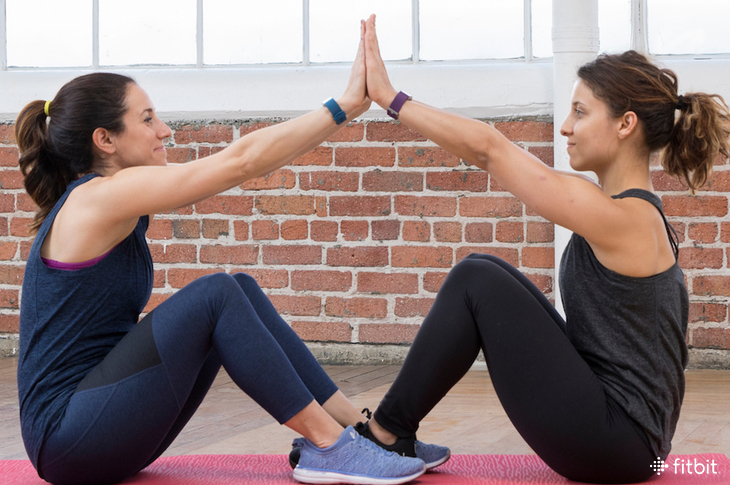
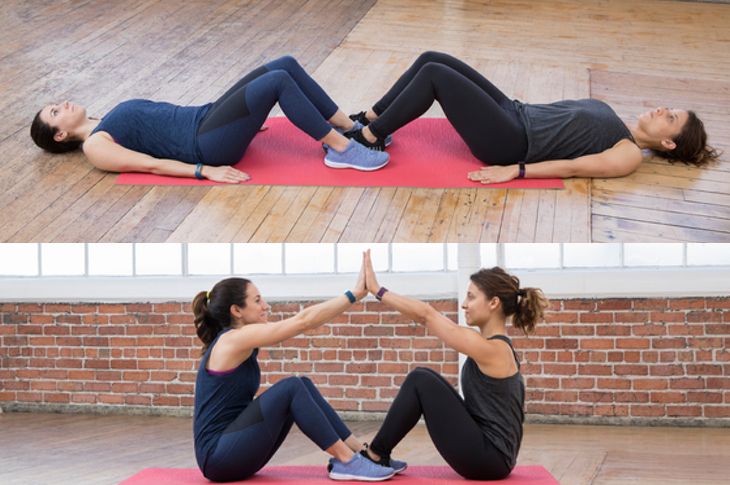
1. Partner Sit-Up With Clap

Partner sit-ups train abdominals.

Tone your tummy while high-fiving your partner on their hard work with this duo-fueled take on a core-building classic.

Directions:

  1. Lay on the floor with your knees bent and feet pressed into the ground.
  2. Have your partner lie down facing you. Interlace their feet with yours.
  3. Squeeze your abs and reach your arms up, clapping hands with your partner as you reach the top of the movement. When contracting, squeeze your feet alongside your partner’s to prevent them from lifting as you sit up.
  4. Lower yourself back down in a slow-and-controlled motion. Aim for 10 reps.

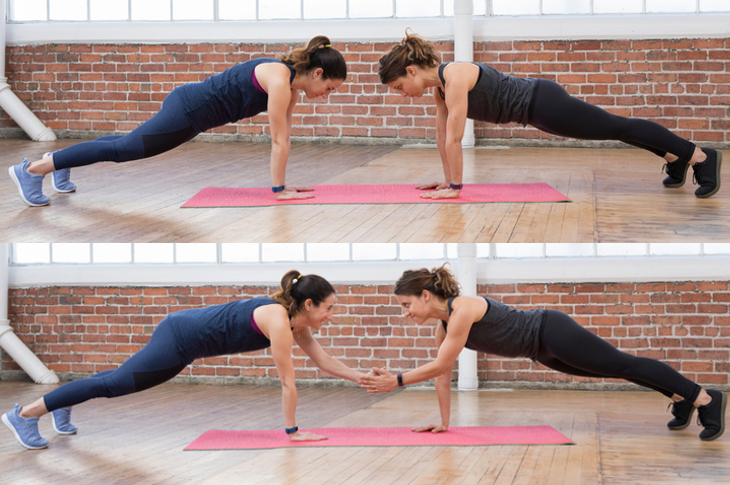
2. Partner Plank With Clap

Partner planks with claps are a great team-building way to fit in isometric training.

Improve balance while working your core, glutes, and hamstrings. Perfect the plank—and add in a little partner love—with this take on a total-body classic.

Directions:

  1. Get on the ground in a push-up position, making sure your shoulders track over your wrists, your hips don’t slump (or overextend), and your core stays tight. Be sure to keep a neutral neck and spine.
  2. Once you have a solid plank—a strong line from your head to your toes—stabilize yourself as needed. If this means widening your foot stance to establish a more-solid base, that’s OK.
  3. Reach out the same hand as your partner, clapping from the side.
  4. Return to the plank position before repeating on the opposite side. Aim for 5 claps on each side or 10 reps total.

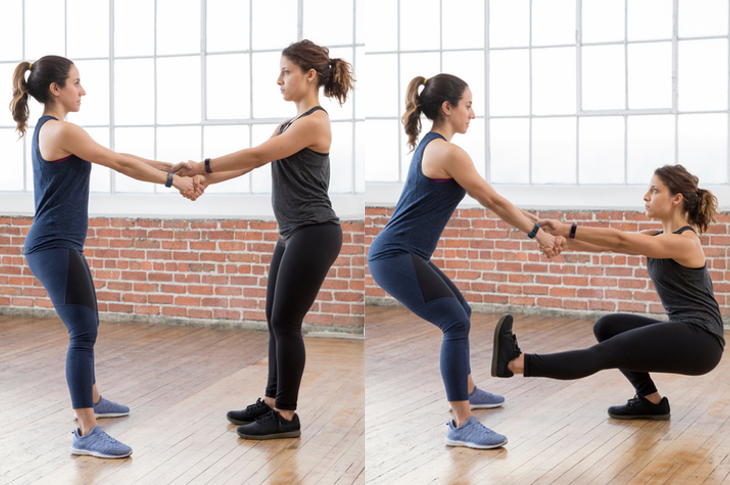
3. Partner-Assisted Pistol Squat

Use your partner for support in pistol squats.

Pistol squats can be challenging, but with a helping hand from a friend, this advanced movement becomes more approachable.

Directions:

  1. With about a foot of distance between you, stand facing your partner.
  2. Cross your arms and hold each others hands for added support.
  3. While your partner hunkers down toward the ground and assumes a slight squat to secure their stance, lower down into a pistol squat—squatting while placing your weight in one leg and slowly extending the other in front of you.
  4. As you come back up in a slow-and-controlled manner, your partner should slowly stand, too. Aim for 5 reps, then switch.

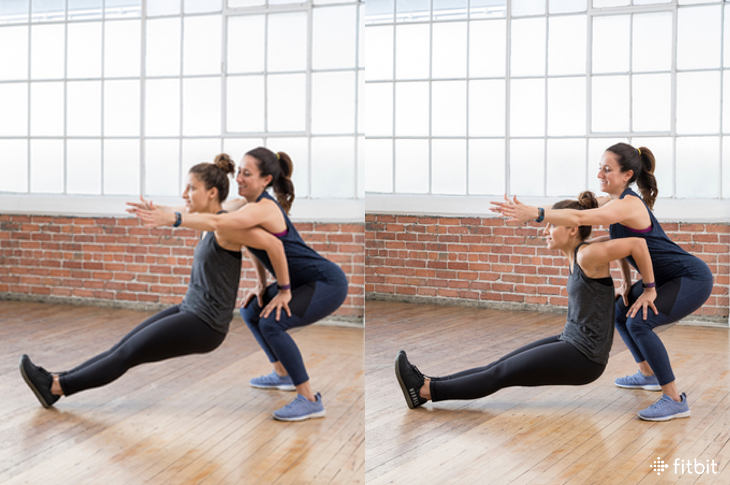
4. Partner Static Squat Holds and Dips

Partner squat holds and dips train your total body.

Celebrate the tradeoff between training triceps and targeting glutes with this workout move that hits both your upper and lower body.

Directions:

  1. Have your partner stand a few feet behind you.
  2. Allow your partner to sink down into a bodyweight squat—keeping the weight in their heels and maintaining an upright torso.
  3. Once they’ve assumed a stable squat, place your hands on their knees. Your fingers should face forward and your elbows should be by your sides in standard dip position.
  4. As your partner holds the squat, slowly lower your body by bending at the elbow until your upper arms are parallel to the floor. Push back to starting position, and repeat for 10 reps. Then, switch positions.

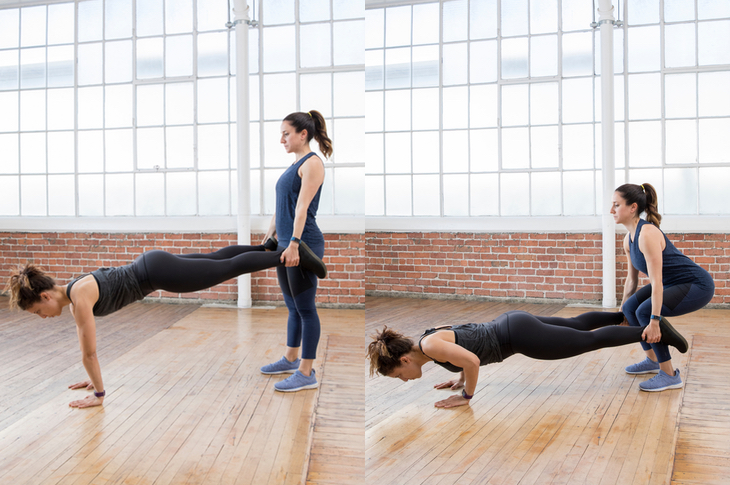
5. Partner Squat and Push-Up

Partner squats and push-ups are a total-body burner.

Get in some squats and feel your arms burn with this two-in-one move.

Directions:

  1. Assume a plank position and have your partner pick up your feet.
  2. Do a push-up—keeping elbows tucked and lowering slowly—while your partner squats down.
  3. As you push back into a plank, have your partner slowly stand back up. Repeat for 10 reps. Then, switch positions.

The post 5 Partner Workout Moves That Put The Fun In Fitness appeared first on Fitbit Blog.


source https://blog.fitbit.com/5-partner-workout-moves-that-put-the-fun-in-fitness/

Saturday, May 2, 2020

Ways To Avoid Weight Gain While Working From Home

Many of us are now spending more time working from home. Chances are you’re feeling a little lost when it comes to figuring out how to make your old routine fit into your new norm. You’re likely noticing changes in your daily habits—the foods you choose, how often you eat, how often you move, when you head to sleep, and how you handle your emotions—all of which may impact your weight and overall wellness. As a Fitbit health coach, I am hearing more and more people ask, “How can I avoid gaining weight while working from home?”

Tips from a Fitbit health coach

Minimize the grazing. Stick to an eating schedule and make sure that you’re consuming wholesome, nutritious meals and snacks every three to five hours. This will ensure that you’re not over or under eating throughout the day. Chances are you’re also less active, so this may mean only three meals a day and no snacks, or simply eating smaller portions. 

Eat mindfully. Add a serving of mindfulness to your meals and snacks. Research shows that by practicing more mindfulness you may be more likely to control your sweet tooth and regulate your blood sugar. 

Perfect your mocktails. A few too many virtual happy hours? Now is the perfect time to try a mocktail! No one has to know there’s no alcohol in that drink, and you can still have fun from your couch while keeping calories in check. Consider trying one of these tiki-themed mocktails!

Enjoy takeout meals with a plan. You can still order in, just don’t go overboard on the greasy fried food, and try not to make it a nightly occurrence. Try to create a healthy plate—that means adding veggies to your order!—and pack away any extras or leftovers before you eat. 

Create a healthier food environment. Keep healthy foods (whole grains, fruits and veggies, lean protein, and healthy fats) at the top of your grocery list. When you get home from the store, chop up your fruits and veggies and have them at eye-level in the fridge. That way, you’re more likely to reach for those when you need a quick snack.

Move throughout the day. All this time at home makes you realize how much you move around during the day, from heading to work and going to the store to running errands and dinner dates with friends. With most of that movement no longer possible, be sure to give your body regular breaks and bump your step count back up by turning on reminders to move. Try dancing in the living room with obĂ©, going up and down the stairs, or walking to the mailbox and back. 

Harness that old commute time. Without the commute, now is the time to prioritize your sleep. New research suggests that playing ‘catch-up’ on the weekends may actually increase your risk of weight gain. Check out our tips for getting a good night’s sleep for simple ways to help you achieve the recommended seven to nine hours of sleep. 

Seek support from your community! If you’re working from home with others, let them know what you need: “I need to keep the cookies downstairs” or “I’m looking for someone to hold me accountable to get out for a walk every day.” If you’re flying solo, connect with friends, family, or colleagues who can support you by text, video calls, or join you in a game of Get Fit Bingo with Fitbit Premium.  

If at the end of your work from home tenure, your weight has gone up and you haven’t reached your health goals, be gentle with yourself. You are not alone. You are not your weight. Now dust yourself off, take note of other things that you are grateful for during this time, and be on your way! 

The post Ways To Avoid Weight Gain While Working From Home appeared first on Fitbit Blog.


source https://blog.fitbit.com/avoid-weight-gain-wfh/

Thursday, April 30, 2020

3 Easy Breathing Techniques to Help You Calm Down Right Now

Breathing is a bit of a no-brainer, literally. You inhale and exhale all day long without giving it a second thought. But here’s the weird thing about your breath: Unlike other automatic functions, like your heart beating, you can also choose to control it and breathe faster or slower than normal. And by doing so, you can have a pretty big impact on your mental health.

“Your breath connects what you’re thinking and how your body feels,” says Belisa Vranich, a clinical psychologist and author of Breathe: The Simple, Revolutionary 14-Day Program to Improve Your Mental and Physical Health. “And it goes in both directions.” In other words, not only does your breath speed up when you get stressed, but breathing quickly can actually bring on feelings of stress. It works the other way too: Slow your breathing down and make your breaths deeper and you will start to quickly feel more relaxed. 

“When people purposefully try to calm down, they credit things like the candle they lit or the mantra they repeated, and those things help,” says Vranich. “But the real impact is because they made you slow your breathing, which is what really relaxed you.”

Breathe This Way

If you haven’t thought about your breath in a while, chances are it’s relatively shallow, which isn’t great. “I call it hover breathing, because you’re taking tiny sips of air in and letting tiny sips of air out,” says Vranich. “It’s one reason why yawning feels so good—you’re finally taking in lots of oxygen!” The other mistake: You’re expanding your chest when you breathe as opposed to your belly and sides. Change your breathing to be deep and expansive low in your torso and you’re already well on your way to feeling more relaxed. If you’re ready for something a little more specific, try these three techniques Vranich recommends to help you feel more peaceful in no time.

Walking Breath: The next time you’re walking down the street, try timing your inhales and exhales to your steps. Inhale for two steps and exhale for two steps. After a few rounds of that, switch to inhaling for two and exhaling for three. “Exhaling for longer than you inhale stimulates your vagus nerve, which activates your parasympathetic nervous system,” says Vranich. “That is what calms you down.”

4-4-6-2: This pattern gets gradually slower as you go, which makes it pretty powerful at relaxing you. Inhale for four seconds, hold for four seconds, exhale for six seconds, hold for two. Keep repeating this pattern but as you go on, start counting slower and slower.

Mouth-to-Nose: Start with three mouth-only breaths (mimic yawning). Then do three breaths where you inhale through your mouth and exhale through your nose. Last, do three breaths inhaling and exhaling through your nose only. “You’ll get a lot of oxygen when you do the yawns,” says Vranich. “And when you switch to your nose, you start getting nitric oxide, which is inherently relaxing.”

The post 3 Easy Breathing Techniques to Help You Calm Down Right Now appeared first on Fitbit Blog.


source https://blog.fitbit.com/breathing-techniques/